Showing posts with label Victoria and Albert Museum. Show all posts

Online Historic Costume Collections

In a click of a mouse, I can visit the historic and contemporary costume collections from around the world. Although some museums and university collections welcome visiting scholars, digitizing a collection reduces the handling of fragile garments and also offers everyone a chance to see garments that are not on display.  Here are my top picks of accessible collections (click on museum name for related link): 

Dior 1947 Bar Suit, Image Courtesy of the Metropolitan Museum of Art Costume Institute
Metropolitan Museum of Art Costume Institute Collection: The Met has over 35,000 costumes and accessories in their collection, with the earliest piece going back to the 15th century. This New York museum sets the gold standard for online digitized collections, providing multiple images and extensive descriptive information and provenance details for each item.

Victoria and Albert Museum Collections:  Although the storage and research facilities for this London based museum collection are currently being renovated (scheduled to reopen in October 2013),  the V&A website gives access to images from their extensive costume collection and also provides videos, articles, suggested books, and related material. An inviting and friendly website, the fashion related section is organized by period, with links to all related material available on the site. Like the Met, the information provided for each fashion item is extensive, including multiple viewpoints, photos of related accessories, marks and inscriptions and exhibition history. 

FIT Museum Collection: FIT Museum currently has over 50,000 garments and accessories in its collection. Although they have pieces going back to the 18th century, their focus is on contemporary fashion and they seek to add new pieces that "make fashion history". They have an extensive online collection and are adding to that regularly.  FIT has a smaller study collection of approximately 1200 pieces that is accessible to students, faculty and visiting researchers.

Kent State University Museum: Kent State has one of the largest study collections in the world with over 40,000 pieces including historic pieces from the 18th and 19th centuries to the present. While only a small sampling of items have been digitized, this museum believes in accessibility and welcomes students, faculty and visiting researchers.


School of the Art Institute of Chicago Fashion Resource Centre: This small, tightly edited collection of 300 garments and accessories focuses on avant-garde fashion from the 20th and 21st century. Items are representative of "extreme innovation" and include designers such as Alexander McQueen, Commes des Garcons, Issey Miyake, Maison Martin Margiela, and Yohji Yamamoto. As well, the centre houses an extensive visual, print, and fabric reference collection to "support and illuminate the garments and the study of attire". The AIC Fashion Resource Centre invites visiting scholars, groups and the public to see its collection by appointment (fees may apply). Selected pieces have been photographed and are included on their website. 

Drexel University Historic Costume Collection: An online collection featuring detail closeups and 360 degree views of 129 selected pieces from the collection. Of particular note are the photos related to the conservation of an 1885 gown by Charles Frederick Worth (link here).


Creative Process Journal: Fashion Dolls

Jointed wooden doll, 17th-18th century
In the seventeenth and eighteenth centuries, fashion dolls were used by dressmakers as a way of illustrating the latest styles to their potential clients. Dolls dressed in the latest Parisian styles were on display in fashionable shops and also were sent regularly to London and to the courts of Europe. The dolls were considered precious and sometimes even had diplomatic immunity during times of war. Although the most fashionable dolls originated from Paris, dolls were also made up in England and sent to the American colonies, where England was the dominant cultural influence.

19th Century Fashion Doll by Simonne Paris c.1877-78
Although fashion dolls were largely supplanted by journals as a tool of disseminating fashion information, they have not disappeared. In 1945, a travelling exhibition of Parisian fashion dolls was conceived and presented called Theatre de la Mode in an effort to restore the haute couture industry after WWII. With outfits designed by Dior, Lucien Lelong, Piguet, Carven, Nina Ricci, Jean Patou, Schiaparelli, the Chambre Syndicale de la Couture showcased the best of French fashion - in miniature. Milliners, shoemakers, glovemakers, and jewelers all contributed to the project to help fulfill the designer's vision.

Theatre de la Mode doll by Lucien Lelong photographed by David Seidner c.1990 
With blank faces, wire bodies and real hair, these small scale mannequins (27.5 inches in height) were clothed in miniature versions of the designer's clothing and accessories. Everything was replicated with precision: pockets opened, buttons could be unbuttoned and handbags unclasped. The effect was surreal and the audience, who had "been starved for beauty, for glamour, for amusement after four years of occupation" streamed in (Braun-Munk et al 46). An estimated 100,000 visitors saw the exhibition in Paris before it travelled to cities like London, Barcelona and New York. The dolls were packed away in a basement in San Francisco for several years before being sent to the Maryhill Museum of Fine Art in Washington. They have been redisplayed on occasion including an exhibition at the Musee des Arts Decoratif in Paris in 1990 and at the Costume Institute of the Metropolitan Museum of Art in 1991.

Theatre de la Mode doll heads, Photograph by David Seidner c.1990
The photographs by David Seidner for the book Théâtre De La Mode seem to embody the essence of Freud's uncanny. Juxtaposed in contemporary contexts, with blurred backgrounds evoking decay, these photos of the dolls present them as objects posited on the boundary between animate and inanimate, life and death. This is fuel for the creative process....

References:

Fox, Carl. Doll. Ed. Herman Landshoff. New York: Abrams, 1972.

Mac Neil, Sylvia. The Paris Collection. Grantsville, Md.: Hobby House Press, 1992.

Théâtre De La Mode. Ed. Eugene Clarence Braun-Munk, Edmonde Charles-Roux, and Susan Train. New York: Rizzoli in cooperation with the Metropolitan Museum of Art, 1991.

Book Review: Seventeenth-Century Dress Patterns, Book One


The cover of this book with the ghostly x-ray image of a slashed satin bodice from 1630 is but a hint of the extraordinary contents within. Edited by Susan North and Jenny Tiramani, Seventeenth-Century Dress Patterns (Book One) includes patterns for items from the Victoria and Albert Museum collection including several waistcoats, a mantle, a smock, hood, gloves and other items. Enhanced by colour photographs, x-ray images, highly detailed patterns, cutting instructions, technique descriptions and images of paintings, the book is intended to provide experts and home-sewers with the means to replicate these pieces as well as minimize the repeated handling of the objects from the museum's collection. Seventeenth-Century Dress Patterns is extraordinary in its content and its beauty and also builds on the cumulative work of Janet Arnold as well as other dress historians like Norah Waugh and Dorothy Burnham.

This is the first book in a new pattern book series published by the Victoria and Albert Museum. The new format was the inspiration of Jenny Tiramani, who not only worked as a costumer for the Shakespeare's Globe Theatre from 1997 to 2005, but also completed Janet Arnold's last book Patterns of Fashion 4 (after Janet's untimely death). Last year, I heard Jenny Tiramani speak at the Royal Ontario Museum when she visited to research some items from the museum's collection (read the post about her talk here). Her attention to detail, willingness to share her knowledge and her charm are reflected within the pages of this meticulously crafted book.

Title: Seventeenth-Century Dress Patterns, Book One
Edited by: Susan North and Jenny Tiramani
Publisher: V&A Publishing, London, 2011
Category: Non-fiction, Historical Dress
Number of Pages: 160

Cartes des Visite and Fashion History

White has been the choice of most brides since the time of Queen Victoria's wedding to Prince Albert in 1840. But surprisingly other colours such as black, blue or brown were also worn in the 19th century by brides who favoured a more practical choice of gown to be worn again. 

From the Halmrash studio, 529 Washington Avenue South, Minneapolis

In this particular photograph, the bride is wearing a dark gown, probably dark blue or black silk. Undated, it took a bit of sleuthing to date this photograph.  

In the Victorian era, collecting cartes de visite of friends, family and prominent persons was a popular pastime. These small  2⅛ × 3½ photographs were supplanted in the early 1870s by the larger sized "cabinet cards" which measured  4½ by 6½ inches. Cabinet cards remained popular into the early 20th century when Kodak introduced the Brownie camera. When I see a tray of cartes de visite or cabinet cards in an antique market, I am compelled to bring them home. Once I bought so many that the vendor asked me if I was buying a family. What I'm actually buying is a bit of fashion history. 

The bride is wearing a black, blue, or brown dress with long sleeves and a high collar with white piping detail and white buttons for the collar opening. The bodice is slim fitting and appears to be a type of corset overlay with two rows of white buttons. The skirt seems to be softly draped across the front and has a small ruffled hem. Her white veil is sheer and to the floor with flowers or other ornament as a type of tiara. 

How would a historian date this dress?

The image is a larger cabinet card for a starting point of at least 1870. But the absence of a bustle suggests that it must be later than 1880. And since the sleeves are not overly extreme in shape as was common in in the mid-1890s, I'm guessing that this dress would be dated somewhere between 1898-1903.

To check, I went to the Victoria and Albert Museum website which offers a treasure trove of information on historical dress and discovered that they have a database of wedding photos. There is a similar style of dress worn by Sarah Poortvliet in her marriage to Fobbe William Hoekstra dated February 14, 1901. How cool is that?

Yohji Yamamoto and the Crinoline

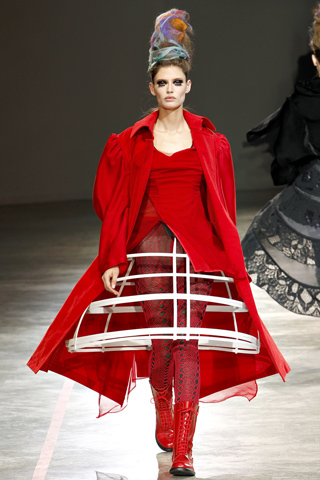
Yohji Yamamoto Fall/winter 2011
Crinolines seem to resurface periodically in contemporary fashion. Their exaggerated proportions and sculptural properties take on a decidedly modern twist in Yohji Yamamoto's Fall/Winter 2011 collection. And the apocalyptic hairdos almost seem to foretell the tragedy of the earthquake and tsunami in Japan.

Yohji Yamamoto Fall/Winter 2011

Yohji Yamamoto, Fall/winter 2011

Yohji Yamamoto Fall/winter 2011

These women are not languishing Victorian wallflowers. Instead the effect is strikingly powerful and modern. Seeing this riff on crinolines makes me want to wear one. I wish I could hop across the pond to see the retrospective of Yohji Yamamoto's work which opened at the Victoria and Albert Museum in London on March 12, 2011. 

To see more examples of crinolines in contemporary fashion, see this earlier post here. 

What's on the Fashion Calendar for March?

The worlds of fashion and art have collided and there seem to be an unprecedented number of promising exhibitions on the calendar.

Worth Evening Gown and shoe by Isabelle de Borchgrave 2004
Photo by Andreas von Einsiedel
Courtesy of the Legion of Honor


Pulp Fashion: The Art of Isabelle de Borchgrave recently opened at the Legion of Honor Museum of Fine Arts in San Francisco. In this exhibition, over 60 paper sculptures from the studio of Isabelle de Borchgrave depict the history of costume. Taking inspiration from paintings, photographs, sketches and museum collections, this artist paints and manipulates paper to look like fabric, which is then styled into the dress silhouettes of the past.  I recall seeing her work in a show called Papier a la Mode at the Royal Ontario Museum  and I've been a fan ever since. In fact, I often revisit her exquisite work inside the beautiful book Paper Illusions, The Art of Isabelle de Borchgrave. 

In Los Angeles, the Fashioning Fashion: European Dress in Detail, 1700-1915 exhibition at LACMA will close at the end of the month. This exhibition examines the changes in fashionable dress over a period of  two hundred years and considers the evolution in textiles, tailoring techniques, and trimmings in the presentation of the museum's relatively recent acquisition of a major European collection. With an incredibly beautiful book filled with breath-taking photos, I'm almost breathless with anticipation at finally getting there.

Also in Los Angeles is the unpretentious FIDM museum where there is an exhibition of  the 19th Annual Art of Motion Picture Costume Design . The Academy award winning costumes from Alice in Wonderland by Collen Atwood are included in the exhibition as are costumes from The Kings' Speech, The Kids are Alright, The Tempest and other movies from 2010.

Installation shot of Punk Garments, 1977-78
From Zandra Rhodes: a life in textiles
Photo by Anthony Scoggins
Courtesy of the Mingei Museum
And of course, there is the exhibition of Zandra Rhodes: A Lifelong Affair with Textiles at the Mingei Museum. This iconic textile artist, fashion designer and costumer will be speaking about her opera costume and set design work on March 19th in San Diego.

Textiles are the first step of the process of creation for designer Yoji Yamamoto.  He once said "Fabric is everything". Using a variety of traditional Japanese techniques and other more common weaves such as gabardine and tweed, Yamamoto has all his fabrics made in Japan to his own specifications. He became internationally renowned for his unconventional designs that incorporate unusual pattern cutting and often seem oversized, unfinished, non-gender specific, or constructed out of non-traditional fabrics like felt or neoprene.  Yoji Yamamoto retrospective at Victoria and Albert Museum opens March 12.

So many places to be, so little time....

The First Fashion Blogger: Barbara Johnson's Album of Fashion


Although fashion blogs seem to be a relatively recent phenomena, the act of documenting one's selections of clothing and fabric choices goes back as far as the 18th century. Barbara Johnson, a  well-off Englishwoman from a clerical family, made detailed notes about her wardrobe for the period 1760-1823. Her album includes a detailed description of each garment, fabric swatches, information about cost and trimmings as well as clipped pocketbook engravings (plates that preceded the illustrated fashion journals) with the styles of the day. Her album survives today in the collections of the Victoria and Albert Museum. It was reproduced into book format in 1987 because it is too fragile to be handled.

Even as a reproduction, this album is important for several reasons. According to Madeleine Ginsburg, assistant curator at the V&A Museum,  "the album is unique for the length of time it covers, for the practical details and the hints it gives of the circumstances of her long and fashion-conscious life." (Essay on "Barbara Johnson and Fashion" by Madeline Ginsburg, pg. 18 from the book.)


Not only does this album reflect the changes in silhouette and style over time, it also mirrors the graceful aging of a woman who knew was appropriate for her figure. Stylish to the end, her choices of fabric, silhouette and trims reflect her status as an elegant and respected woman.

Also notable in the album are her frequent purchases of mourning dress. Apparently, 18th century mourning requirements were as strict as in the Victorian age with three periods of mourning, categorized by degree. First degree required the most sombre dress in fabrics without colour, either in black or white, without sheen and with little or no trimmings and plain white accessories. Over time, the requirements relaxed but the mourning period was typically at least a year and was adopted after the deaths of family, close friends and in certain cases for the deaths of members of the Royal Family.

This book is a fascinating archive of fashion history for the period 1754-1832 and an important resource for fashion scholars and bloggers alike.

Title: Barbara Johnson's Album of Fashions and Fabrics
Edited by: Natalie Rothstein
Published by: Thames and Hudson, 1987
Number of Pages: 208
 
Copyright © Fashion and Hairstyles. All Rights Reserved.
Blogger Template designed by Big Homes.